
Gwinnett County · Elections · Evergreen Guide
Gwinnett County Election Integrity
Election integrity in Gwinnett County — voter rolls, the Board of Registrations and Elections, voter challenges, certification, recounts, and how elections are secured.
Last verified: August 7, 2026
Election integrity is about whether the system works — whether voter rolls are accurate, ballots are handled properly, results are certified transparently, and every legal vote counts. In Gwinnett County, election integrity is overseen by the Board of Registrations and Elections, the Georgia Secretary of State, and a framework of state law that governs voter-roll maintenance, challenges, recounts, and certification.
This guide explains how election integrity works in Gwinnett, who is responsible, and where to find verified information when questions arise.
Key Takeaways
- •The Gwinnett County Board of Registrations and Elections administers elections and maintains voter rolls.
- •Georgia law allows registered voters to challenge other voters' registrations.
- •Certification is a public process required before results are official.
- •Georgia uses a verified paper-ballot system with post-election risk-limiting audits.
- •WorthFighting.org separates verified facts from commentary in election integrity reporting.
Who Runs Elections in Gwinnett County?
Gwinnett County elections are administered by the Board of Registrations and Elections, a body appointed under Georgia law. The board:
- Maintains the county voter rolls
- Certifies election results
- Oversees advance voting and Election Day operations
- Processes voter-registration applications and updates
- Adjudicates voter challenges
The board works under the authority of the Georgia Secretary of State, which sets the statewide election calendar, certifies results, and maintains the statewide voter registration system (SEB).
Voter Rolls and Roll Maintenance
Gwinnett's voter rolls are part of the statewide Georgia Voter Registration System. Roll maintenance is an ongoing process that includes:
- Adding new registrations — when voters register or update their information
- Removing ineligible voters — when voters die, move out of the county, or are convicted of felonies (under Georgia law, felons may have voting rights restored after completing their sentence)
- Processing address updates — when voters move within or out of Gwinnett
- Responding to voter challenges — when a registered voter formally challenges another voter's eligibility
The Secretary of State's office also participates in cross-state data-sharing through the Electronic Registration Information Center (ERIC) and other mechanisms to identify voters who have moved or died in other states.
Voter Challenges in Gwinnett
Georgia law (O.C.G.A. § 21-2-230) allows any registered voter to challenge the registration of another voter in their county if they believe the registration is improper. The challenge is filed with the Board of Registrations and Elections, which holds a hearing and makes a determination.
Common grounds for a voter challenge include:
- The voter has moved out of Gwinnett County
- The voter is not a U.S. citizen
- The voter is deceased
- The voter is otherwise ineligible under Georgia law
Voter challenges have become a focus of election integrity advocacy in Gwinnett and across Georgia, with grassroots organizations filing challenges to remove voters they believe should no longer be on the rolls.
Certification of Election Results
After every election, the Gwinnett County Board of Registrations and Elections meets to certify the results. Certification is the formal process of confirming that:
- All ballots were counted correctly
- The totals are accurate
- The election was conducted in accordance with state law
Certification is a public process. The board's certification meeting is open, and the certified results are published and transmitted to the Secretary of State. Results are not official until certified.
Recounts
A recount is a re-tabulation of ballots. In Georgia, recounts can be triggered by:
- A close margin — if the margin between candidates is less than or equal to a certain percentage (typically 0.5% or less), a candidate may request a recount
- A candidate request — candidates in certain races may petition for a recount
Gwinnett recounts are conducted by the Board of Registrations and Elections under the supervision of the Secretary of State.
Election Security
Georgia uses a verified paper-ballot system. Voters mark a paper ballot by hand or using a ballot-marking device, then feed it into an optical scanner that records the vote. The paper ballots are retained as the official record and can be used in a recount or audit.
Key security features include:
- Paper ballots — the physical record of every vote, retained for audits and recounts
- Risk-limiting audits — post-election audits that compare paper ballots to machine totals
- Chain of custody — documented handling of ballots and equipment from the polling place to certification
- Testing and certification — voting equipment is tested and certified before each election
Verified Facts vs. Commentary
WorthFighting.org distinguishes between verified facts about election administration and conservative commentary on election policy. When we report on election integrity:
- Verified facts — we cite official sources, meeting minutes, certified results, and state law
- Commentary — we label opinion and analysis clearly, separate from factual reporting
For our latest Gwinnett election integrity reporting, see the Election Integrity section below and our election news coverage.
Key Takeaways
- The Gwinnett County Board of Registrations and Elections runs county elections and maintains voter rolls
- Georgia law allows registered voters to challenge other voters' registrations
- Certification is the formal process of confirming results — it is public and required before results are official
- Georgia uses a verified paper-ballot system with post-election risk-limiting audits
- WorthFighting.org separates verified facts from commentary in election integrity reporting
Where to Verify
- Gwinnett County Board of Registrations and Elections — county election authority
- Georgia Secretary of State — Elections Division — state election authority
- Georgia Election Code (O.C.G.A. Title 21) — the law governing elections in Georgia
Official Sources
County-level election authority — voter registration, early voting locations, polling places, and certified results for Gwinnett County.
State-level election authority — statewide calendar, candidate qualification, election rules, and certification.
Official voter portal — check your registration, view your sample ballot, find your polling place, and track your absentee ballot.
Official 2026 election calendar from the Georgia Secretary of State, including all deadlines and early-voting windows.
County government homepage — commissioners, budgets, and official notices that affect Gwinnett elections.
Last verified: August 7, 2026. Always confirm dates and deadlines with official sources before an election.
Related Gwinnett Election News
Recent WorthFighting.org reporting related to this guide.
Elections
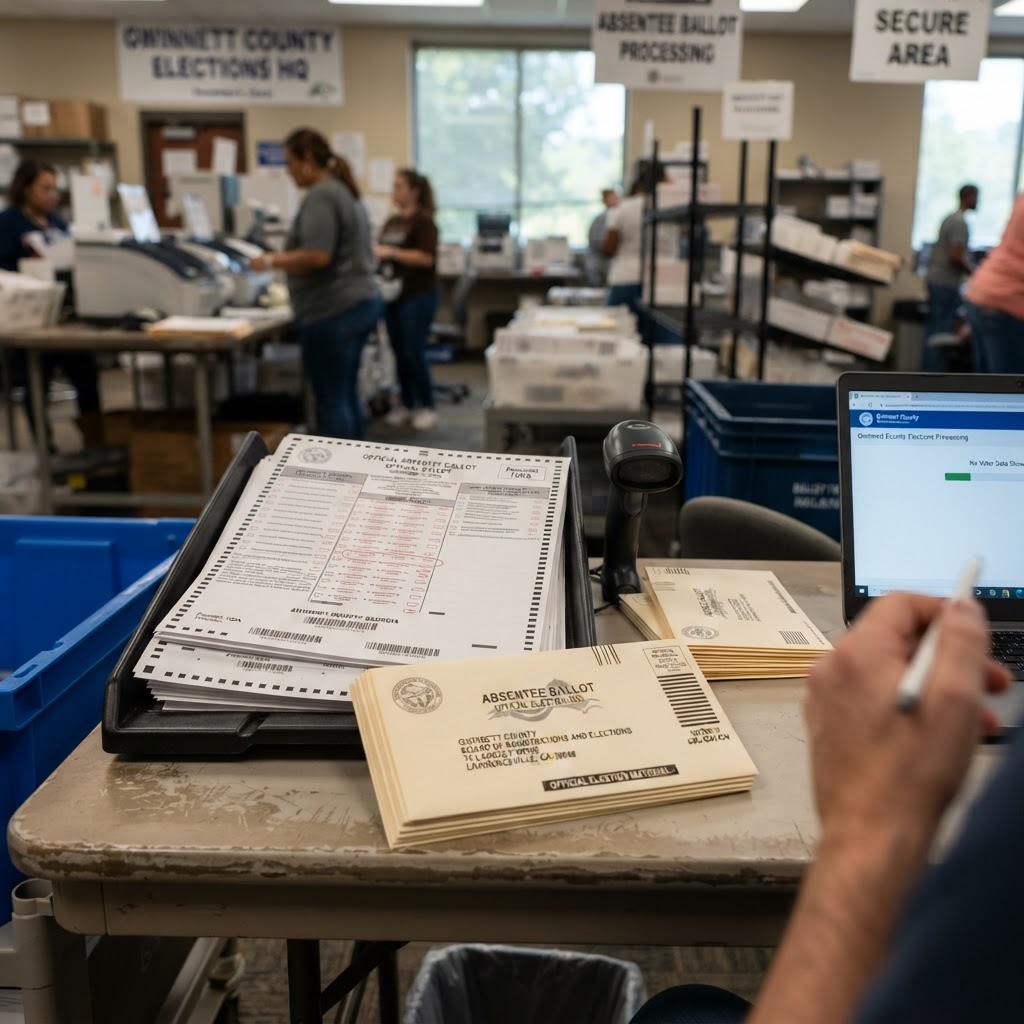
Who Prints Gwinnett County's Ballots? Inside the $347,278 Ballot Printing and Vote-by-Mail Contract
Gwinnett County's ballots are printed by Fort Orange Press, Inc., a 120-year-old company in Albany, New York. The annual contract covers ballot printing, absentee ballot processing, and mailing — with strict security requirements including Dominion-qualified printing and chain-of-custody controls. Here is what the contractor does, what the county does, and what voters should know.

Elections
Gwinnett District Attorney Challenges Georgia Law Impacting Gwinnett County Election Integrity
Gwinnett DA Patsy Austin-Gatson sues to block HB 369, a law removing party labels from local ballots, sparking a debate over Gwinnett County election integrity.
Lawrenceville, Georgia · Aug 30, 2026

Elections
Election Integrity Probe: Norcross to Hand-Count Ballots Amid Gwinnett Security Concerns
Norcross officials announce a hand-count for the special election as an election integrity probe scrutinizes Gwinnett County's voting security and resources.

Elections
Election Integrity: Gwinnett Board of Registrations and Elections Certifies District 13 Results
The Gwinnett Board of Registrations and Elections finalized the District 13 special election results in Lawrenceville, emphasizing new state integrity rules.
Lawrenceville, Georgia · Aug 7, 2026

Elections
Gwinnett County Special Election: Runoffs Set as Voters Demand Accountability
Gwinnett County special election results from July 28 trigger runoffs as Lawrenceville voters prioritize election integrity and government accountability.
Lawrenceville, Georgia · Aug 7, 2026

Elections
Fighting for Fair Elections: Gwinnett County Voter Roll Challenges Intensify
Gwinnett County voter roll challenges are mounting as activists push for clean lists. Discover how Lawrenceville leaders are handling the integrity debate.
Lawrenceville, Georgia · Aug 7, 2026
Explore Gwinnett Elections
Gwinnett County Election Dates 2026
Verified 2026 election calendar for Gwinnett County — primary, runoff, general election, registration deadlines, and early voting windows.
Gwinnett County Voter Registration Guide
How to register to vote in Gwinnett County — online, by mail, or in person — plus deadlines, what to bring, and how to check or update your registration.
Gwinnett County Early Voting Guide
Advance in-person voting in Gwinnett County — 2026 dates, how to find locations, what to bring, and how early voting differs from Election Day.
Gwinnett County Sample Ballot Guide
How to view your Gwinnett County sample ballot, what's on it, and why you should review it before voting — from the official Georgia My Voter Page.
Related Gwinnett Hubs