Community
How Duluth, Georgia Became One of the South's Korean-American Hubs
Duluth, Gwinnett County County, Georgia
Duluth is ~9% Korean and Gwinnett holds nearly half of Georgia's Korean population. Here's how Pleasant Hill Road became the South's Korean commercial corridor — and how Duluth built a model for welcoming a growing community.
Key Takeaways
- •Duluth's Korean population is approximately 2,924 residents — about 9.15% of the city.
- •Gwinnett County holds nearly 47% of Georgia's entire Korean population (~30,053 residents).
- •Duluth ranks 4th among Georgia cities for Korean population, behind Johns Creek, Atlanta, and Suwanee.
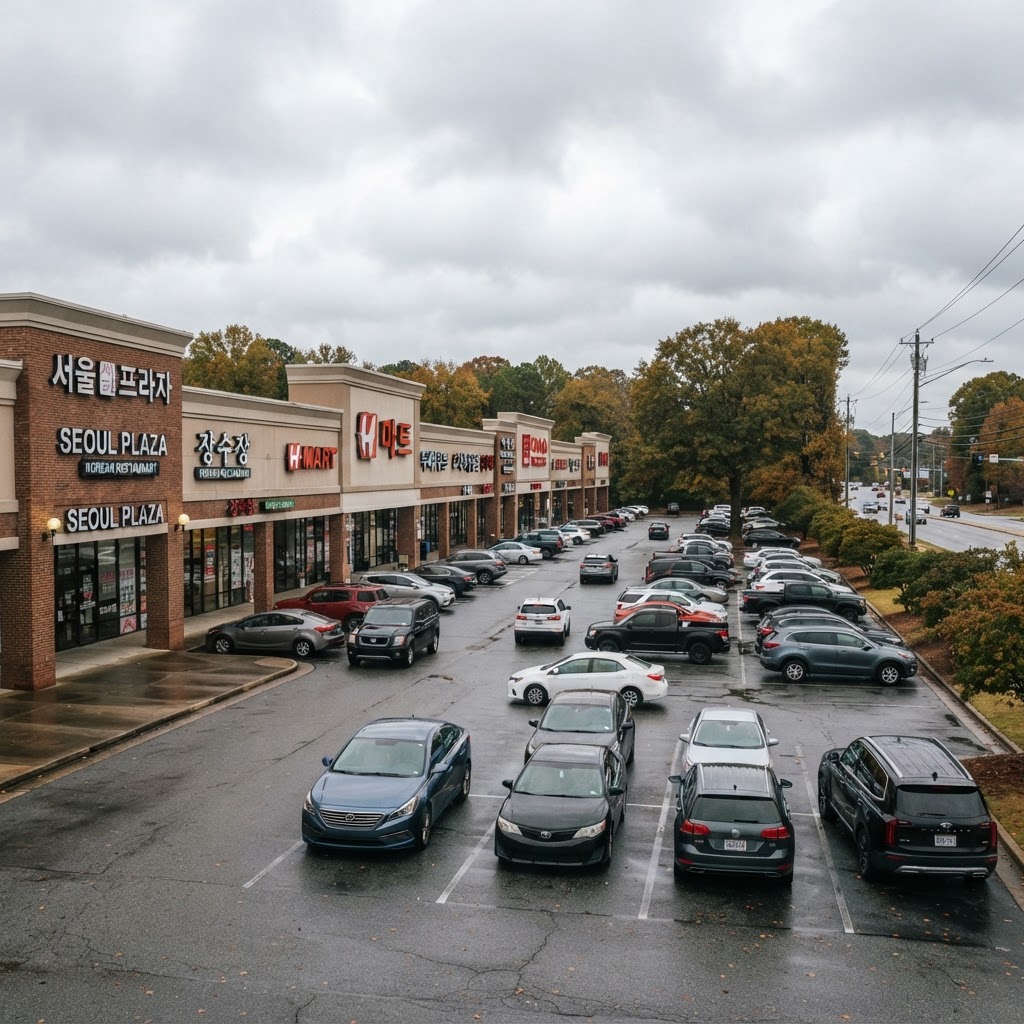
- •Park Village Shopping Center transformed from largely vacant to 50+ Korean businesses.
- •Duluth's Korean Task Force was created to address cultural misunderstandings around soju service, not deliberate lawbreaking.
- •Explore Gwinnett brands the area the 'Seoul of the South' and runs a popular Korean food tour.
- •South Korean corporations operating in Georgia employ more than 9,400 Georgians — separate from Korean-American local businesses.
Duluth, Georgia is home to one of the largest Korean-American communities in the South. The incorporated city of roughly 31,800 residents is approximately 9% Korean, and Gwinnett County holds nearly half of Georgia's entire Korean population. Pleasant Hill Road has become the commercial heart of that community — what Duluth's own economic development manager once called "the most dynamic retail business area in the state of Georgia for Korean-owned businesses."
How Many Korean Americans Live in Duluth?
The most recent American Community Survey data estimates the City of Duluth's Korean population at 2,924 residents — approximately 9.15% of the city's total population (31,873 in the 2020 Census; ~33,800 in 2025 estimates). This figure includes individuals identifying as Korean alone or in combination with other ancestries.
Gwinnett County is home to approximately 30,053 Korean residents — nearly 47% of all Korean residents in Georgia. The state's total Korean-American population is estimated at approximately 150,000. Duluth ranks 4th among Georgia cities for Korean population, behind Johns Creek, Atlanta, and Suwanee.
City Limits vs. Mailing Address — A Critical Distinction
These numbers refer to the incorporated City of Duluth — approximately 10.2 square miles. Many addresses with a "Duluth, GA" postal designation are actually in unincorporated Gwinnett County, making the broader Duluth area's Korean population significantly larger than city figures alone. Mixing city and county figures produces inaccurate numbers.
Population History
| Year | Duluth Korean Population | Gwinnett Korean Population |
|---|---|---|
| 2000 | Not separately reported | Growing |
| 2010 | Part of 82% AAPI growth | Significant increase |
| 2020 | ~2,900+ (Census/ACS) | ~30,000+ |
| 2025 (ACS) | 2,924 | 30,053 |
Between 2000 and 2010, Georgia saw an 82% growth in the Asian American and Pacific Islander population, with Korean Americans accounting for a large portion of that increase.
Why Did Korean Americans Move to Duluth?
- I-85 access — Direct interstate connection to Atlanta and the airport
- High-performing schools — Gwinnett County Public Schools drew families
- Lower housing and business costs — Compared to Los Angeles, New York, and Chicago
- Existing Korean community — Churches, businesses, and immigration networks
- Business opportunities — Lower commercial rents than established corridors
As Judy Yi of the nonprofit Center for Pan Asian Community Services explained: "There's a lot of migration of Koreans from the bigger cities, like L.A., New York or Chicago. Those who are comfortably business owners, they come down to the South because the cost of living is so much cheaper." A common joke among Duluth's Korean residents: "If you got your house in L.A. and you sell your business in L.A., you can come to Atlanta and buy a house and two businesses."
From Doraville to Gwinnett County
Atlanta's Korean community was originally centered in the Doraville and Buford Highway corridor. As families sought suburban growth, larger homes, and better school districts, the community shifted north into Gwinnett County — first to Norcross, then to Duluth and Suwanee. The migration accelerated in the 1990s and 2000s as Gwinnett's population grew from 588,448 in 2000 to 957,062 in 2020. Read our investigation of Pleasant Hill Road traffic to understand how the corridor's infrastructure evolved alongside this commercial growth.
How Pleasant Hill Road Became the Heart of Korean Duluth
Christopher McGahee, Duluth's economic development manager, described the corridor plainly: "Pleasant Hill Road, from there to I-85 and across I-85, is probably the most dynamic retail business area in the state of Georgia for Korean-owned businesses."
The corridor includes:
- Park Village Shopping Center — once largely vacant, now home to 50+ Korean businesses
- Howell Center plaza on Peachtree Industrial Boulevard
- Super H Mart — a major Korean supermarket anchor
- Korean restaurants, bakeries, cafes, banks, medical offices, beauty businesses, and professional services
The transformation of Park Village is one of the most visible signs of the community's growth. Less than a decade before the Korean commercial boom, most of its suites were vacant. Today it is a one-stop retail destination where a visitor can eat Korean barbecue, buy groceries, get a haircut, and visit a Korean-speaking dentist without leaving the parking lot.
Korean Entrepreneurship Helped Transform Duluth
- Commercial occupancy — Shopping centers that had high vacancies filled with Korean businesses
- Restaurant growth — Korean barbecue, fried chicken, tofu houses, and bakeries drew regional customers
- Employment — Korean businesses created jobs for both Korean and non-Korean residents
- Property development — Korean investment helped redevelop underused commercial space
- Tourism — Duluth became a regional destination for Korean food and culture
The City of Duluth's history page notes more than 1,750 businesses within city limits — a commercial base that Korean entrepreneurs significantly expanded.
Why Duluth Became a Destination for Korean Food
Duluth's Korean food scene spans the full range of Korean cuisine: Korean barbecue, Korean fried chicken, tofu houses, noodle restaurants, bakeries, cafes, Korean supermarkets (H Mart and others), and food courts. Explore Gwinnett, the county's tourism arm, has branded the area the "Seoul of the South" and runs a popular Korean food tour visiting four restaurants and cultural hotspots, starting at Explore Gwinnett's office on Sugarloaf Parkway in Duluth.
Is Duluth Georgia's Koreatown?
Duluth is frequently described as Georgia's Koreatown, but "Koreatown" is an informal cultural and geographic description, not an official government designation. The City of Duluth does not officially designate a Koreatown district. The term is used because the concentration of Korean businesses along Pleasant Hill Road is visible, substantial, and regionally recognized. The "Seoul of the South" branding captures the same reality.
Korean Churches and Community Institutions
Korean churches have played a central role in the community's growth, providing worship, community networks, immigrant assistance, cultural continuity, and youth programs. The network of Korean churches was one of the factors that drew Korean families to Duluth — churches provided a support system before the commercial corridor was fully established.
Duluth's Korean Task Force
One of the most innovative local government responses to Korean population growth was the Korean Task Force (KTF), formed by Mayor Nancy Harris after she noticed a spike in alcohol license revocations among Korean merchants.
Why It Was Created
The most common violation was serving soju by the bottle — a traditional Korean gesture of hospitality — and leaving it on the table for patrons to serve themselves. In Georgia, soju is classified as liquor, and this practice violated state alcohol regulations. The violations stemmed from cultural differences, not deliberate lawbreaking.
What It Did
- Alcohol training — The KTF recommended mandatory alcohol vendor training, the first in Gwinnett County offered in both Korean and English (materials translated by the Center for Pan Asian Community Services)
- Bilingual signage — KTF members accompanied the mayor and police on door-to-door visits to Korean businesses, asking owners to add English signage and larger suite numbers so emergency responders could locate them
- Liaison role — The KTF served as a bridge between city government and the Korean business community
Who Led It
The task force included Mayor Harris, city council members, Duluth's first Korean-American associate judge Chung H. Lee, and community volunteers Clayton Lee (East West Bank) and Jenny Wesselmann (Sperry Van Ness).
Results
- Alcohol revocations dropped the year after the training program launched
- Most Korean businesses installed English signage voluntarily — Duluth does not require bilingual signage by law
- The Georgia Municipal Association and Georgia Trend magazine named Duluth a "Trendsetter City" citing the Korean Task Force
- Other Georgia cities contacted Harris asking how to implement similar programs
Korean Culture's Influence on Modern Duluth
Korean cultural influence is visible throughout Duluth: Hangul signage alongside English on storefronts, Korean supermarkets serving a regional customer base, Korean-language media, festivals and K-pop events, cultural organizations, and Korean cuisine as a defining feature of Duluth's restaurant scene. These elements have become part of Duluth's broader identity — not as foreign imports, but as features of a community that has grown organically over decades.
Language
Korean is among the most commonly spoken non-English languages in Duluth and Gwinnett County. The community's growth prompted language-access efforts: local hospitals hired Korean-speaking staff and offered comforts like juk (rice porridge) and Korean-language newspapers; the Duluth Police Department enlisted volunteer translators and hired two Korean-speaking officers among its 43 uniformed officers; and the Korean Task Force's bilingual approach became a model for business outreach.
The Economic Impact
Duluth's Korean community has had a measurable economic impact: business growth, commercial redevelopment (Park Village from vacant to fully occupied), employment, tourism, and international investment. South Korean corporations operating in Georgia employ more than 9,400 Georgians (2023 Georgia Korea Connection report).
It is important to distinguish Korean-American local businesses — the restaurants, supermarkets, and professional services along Pleasant Hill Road — from South Korean corporations operating in Georgia (Kia, Hyundai, SK, LG, and others). Both contribute to Georgia's economy, but they are different categories.
Korean-American Civic Participation
Korean-American civic participation in Gwinnett has grown: Korean Americans serving on city boards and in advisory roles, Korean business associations engaging with chambers of commerce, cultural and service organizations, and growing engagement with local elections. This participation is nonpartisan — Korean Americans, like any community, hold diverse political views.
Duluth's Korean Community Today
Duluth's Korean-American community is an established part of the city's identity — no longer a "new" population, but a community with deep roots, second and third-generation families, churches, schools, and businesses. The community's growth connects to broader Duluth issues WorthFighting has investigated: development pressure, infrastructure spending, property taxes, and traffic congestion.
Five Under-Covered Facts
- Park Village Shopping Center was largely vacant before Korean businesses moved in — The transformation to 50+ Korean businesses is one of Gwinnett's most dramatic commercial redevelopments
- Duluth's Korean Task Force was created because of soju — The cultural practice of serving soju by the bottle, not deliberate lawbreaking, drove alcohol license revocations
- The Duluth Police Department hired two Korean-speaking officers — A specific language-access investment rarely mentioned in demographic coverage
- South Korean corporations employ more than 9,400 Georgians — Separate from Korean-American local businesses
- Duluth ranks 4th among Georgia cities for Korean population — Behind Johns Creek, Atlanta, and Suwanee
Frequently Asked Questions
How many Koreans live in Duluth GA?
Approximately 2,924 residents identify as Korean (alone or in combination) in the incorporated City of Duluth (2025 ACS). The broader Duluth postal area has a larger Korean population.
What percentage of Duluth is Korean?
Approximately 9.15% of the incorporated City of Duluth.
Why are there so many Koreans in Duluth Georgia?
I-85 access, strong schools, lower housing costs than major cities, and an existing Korean community of churches and businesses. Many migrated from Los Angeles, New York, and Chicago.
Is Duluth GA a Koreatown?
Duluth is informally called Georgia's Koreatown due to the concentration of Korean businesses along Pleasant Hill Road, but the city does not officially designate a Koreatown district.
Where is Atlanta's Koreatown?
Atlanta's Korean community was originally centered in Doraville and Buford Highway. The commercial center shifted north to Duluth and Gwinnett County.
Why are there so many Korean restaurants in Duluth?
Korean entrepreneurs opened restaurants along Pleasant Hill Road to serve the growing Korean-American population, and the corridor became a regional food destination.
Does Duluth have the largest Korean population in Georgia?
No. Duluth ranks 4th, behind Johns Creek, Atlanta, and Suwanee. Gwinnett County as a whole has ~30,053 Korean residents.
How many Korean Americans live in Gwinnett County?
Approximately 30,053 — nearly 47% of all Korean residents in Georgia.
Sources & Methodology
This article draws on U.S. Census Bureau and American Community Survey data, City of Duluth government records, Gwinnett County sources, Explore Gwinnett tourism information, and historical reporting on the Korean Task Force. Population figures specify whether they refer to the incorporated City of Duluth, unincorporated Gwinnett County, or the broader Duluth area.
Important Data Distinctions
- Korean alone vs. Korean in combination vs. Korean ancestry — different Census categories
- Asian population is broader and not a substitute for Korean-specific data
- City of Duluth (~10.2 sq mi) vs. Duluth mailing address (includes unincorporated Gwinnett) vs. Gwinnett County
ACS estimates have margins of error, particularly for smaller geographies.
Official Sources
- U.S. Census Bureau — Duluth QuickFacts
- Neilsberg — Korean Population in Gwinnett County by City
- City of Duluth — History
- Explore Gwinnett — Seoul of the South
- Georgia Korea Connection 2023
- Character Media — Korean Population Boom
- Patch — Korean Task Force Bilingual Signage
This article will be updated as new Census/ACS data becomes available.
More Gwinnett County Coverage
For more reporting from across Gwinnett County — Lawrenceville, Duluth, Norcross, Snellville, Suwanee, and every community in the county — visit our Gwinnett County news hub, or browse all local news from WorthFighting.org.
Sources
Explore Georgia
Explore more news, elections, representatives, and information from Georgia.
Visit Georgia State ProfileMore Gwinnett County coverage
Explore the Community hub, the Gwinnett County hub, and related topic hubs.