Local Government
Who Pays for Duluth's Growth? Developers or Taxpayers?
Duluth, Gwinnett County County, Georgia
Duluth's population has grown 44% since 2000, and Gwinnett County has crossed one million residents. We investigated the records to determine who actually pays for the roads, schools, water lines, and public safety that growth requires — and found that Gwinnett does not charge formal impact fees.

Key Takeaways
- •Duluth's population grew 44% from 2000 to 2020, from 22,122 to 31,873 residents.
- •Gwinnett County does not charge formal development impact fees; it has used case-by-case Development Agreements since 1993.
- •Duluth's permit and rezoning fees are processing fees, not infrastructure contributions.
- •Water and sewer System Development Charges function as utility impact fees — $6,747 per single-family home.
- •SPLOST has funded over $2.9 billion in infrastructure since 1985, saving more than $1 billion in financing costs.
- •School buildings are funded by E-SPLOST (sales tax); teacher salaries are funded by property taxes.
- •Police and fire services are recurring operating costs funded through annual budgets, not developer contributions.
Duluth, Georgia has grown from 22,122 residents in 2000 to roughly 31,873 in 2020 — a 44% increase in two decades. Surrounding Gwinnett County crossed the one-million-resident threshold in 2024, making it one of the fastest-growing counties in the Southeast.
With that growth has come apartments, townhomes, mixed-use developments, medical offices, and commercial corridors. Each new household needs roads, water, sewer, schools, police, and fire protection. The central question for existing residents is straightforward: who pays for that infrastructure — the developers building it, or the taxpayers already here?
The answer, based on a review of City of Duluth fee schedules, Gwinnett County development regulations, water/sewer rate structures, SPLOST records, and state law, is more complicated than either side of the growth debate typically acknowledges.
A Critical Distinction: City of Duluth vs. Unincorporated Gwinnett County
Before following the money, it is essential to understand which government has jurisdiction. Many developments with a "Duluth" mailing address fall outside the Duluth city limits in unincorporated Gwinnett County.
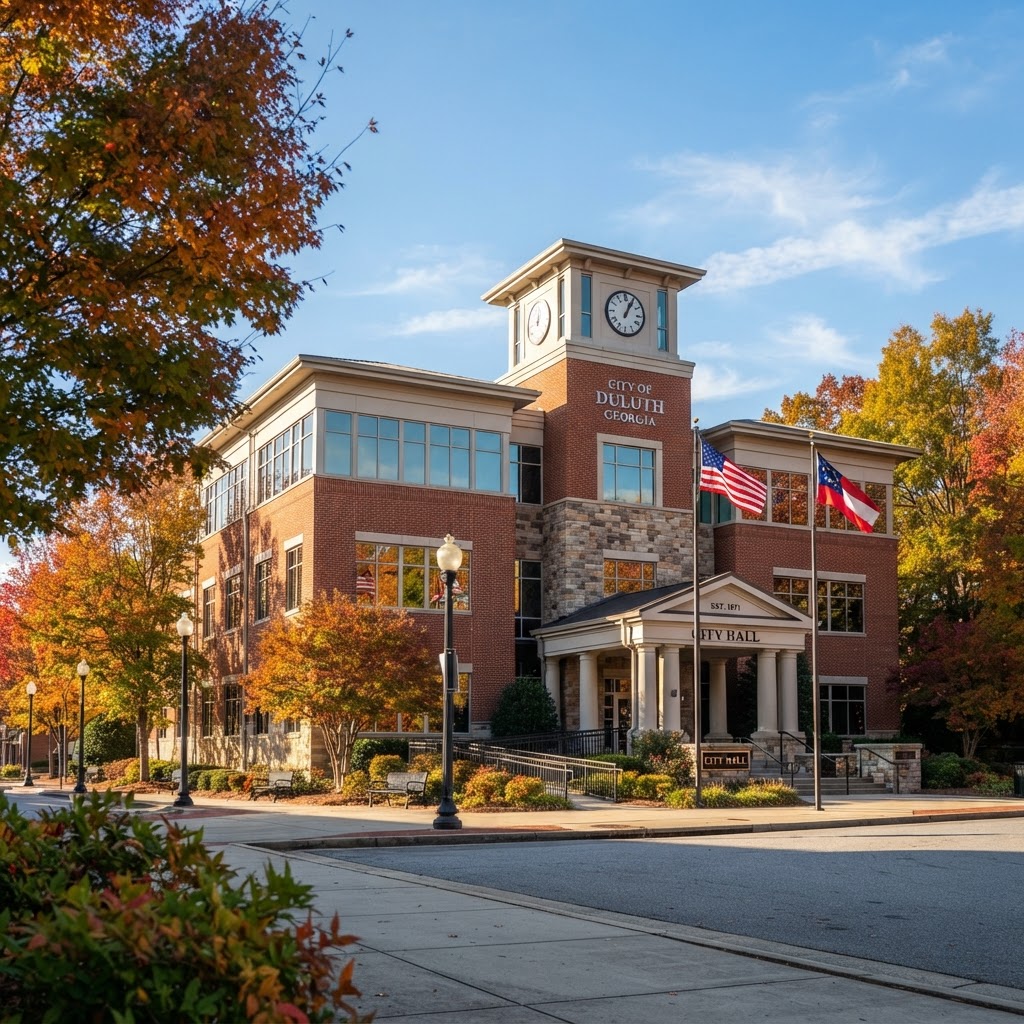
The City of Duluth has its own planning department, building permits, police department, and fee schedule. Developments within city limits go through Duluth's Planning Commission and City Council.
Unincorporated Gwinnett County — including many areas with Duluth addresses — is governed by the Gwinnett County Board of Commissioners. Police service comes from the Gwinnett County Police Department's Central Precinct at 3125 Satellite Boulevard. Fire and EMS come from Gwinnett County Fire & Emergency Services.
The proposed 1,400-home Portman Holdings development at 3554 McClure Bridge Road falls within the City of Duluth's jurisdiction, according to its Development of Regional Impact filing. Other developments commonly described as "in Duluth" may actually be in unincorporated county territory.
Does Gwinnett County Charge Impact Fees?
This is one of the most under-covered questions in local development policy. The answer: No — Gwinnett County does not charge formal development impact fees.
Georgia's Development Impact Fee Act (O.C.G.A. § 36-71-1 et seq.), enacted in 1990, authorizes local governments to charge new development a "proportionate share of the cost of system improvements." However, the law does not require counties to adopt impact fees — it merely permits them.
According to a Gwinnett County Department of Planning & Development form (DPR-56, revised May 2006), "Gwinnett County chose to implement Development Agreements on 22 June 1993" in lieu of adopting a Transportation Impact Fee Ordinance.
What this means in practice: instead of a standardized, formula-based fee that every developer pays per unit, Gwinnett negotiates infrastructure contributions case by case through "Development Agreements." These agreements primarily require developers to donate right-of-way on major thoroughfares for future road widening, in accordance with the county's Long Range Road Classification Map.
If right-of-way is required based on the map, the county will not issue a Development Permit unless the property owner either submits a Development Agreement or a Waiver. The form notes that if the county ever adopts a formal Transportation Impact Fee Ordinance within six years of an executed agreement, developers who signed agreements would receive a credit against future fees.
The practical consequence: there is no automatic, per-unit fee that developers pay toward roads, schools, police, or fire in Gwinnett County. Infrastructure contributions are negotiated individually, and the primary mechanism is right-of-way donation rather than cash payments.
The City of Duluth does not appear to levy its own impact fees either. Its fee schedule — detailed below — is structured around processing and inspection costs.
What Developers Actually Pay: Duluth's Fee Schedule
The City of Duluth's adopted fee schedule states that it "serves to maintain Duluth's competitiveness in the region while accounting for the costs related to the time that is involved in reviewing a variety of applications and completing inspections."
In other words: these are processing fees, not infrastructure contributions.
Key fees include:
| Fee Type | Amount |
|---|---|
| Rezoning — Planned Unit Development | $1,725 + $50/acre |
| Rezoning — Commercial/Multi-Family | $1,325 + $50/acre |
| Rezoning — Single Family | $725 + $50/acre |
| Special Use — Commercial/Multi-Family | $700 + $50/acre |
| Building Permit — New Construction | $1.10/sq ft |
| Land Disturbance Permit (10+ acres) | $100/acre (max $2,000) |
| Certificate of Occupancy | $100 |
| Annexation (standalone hearing) | $750 |
For the proposed 111.55-acre Portman Holdings PUD rezoning, the city rezoning fee would total approximately $1,725 + ($50 × 111.55) = $7,303 — a processing fee that covers staff review time, not road or school capacity.
Water and Sewer: The Closest Thing to Impact Fees
While Gwinnett lacks formal road impact fees, its water and sewer system does charge what are effectively capacity-based connection fees. Gwinnett County Water Resources calls them "System Development Charges" (SDCs) — one-time fees assessed when a new meter is set.
According to the 2026 DWR Rates and Fee Schedule, the SDC is described as covering "the customer's pro-rated share of the costs incurred by Gwinnett County Water Resources for the construction of the water and sewer system infrastructure."
| Meter Size | Typical Use | Total New Connection Cost |
|---|---|---|
| 3/4" | Single-family home | $6,747 |
| 1" | Large home / small commercial | $18,524 |
| 2" | Small commercial / multi-family | $77,186 |
| 4" | Medium commercial | $299,855 |
| 6" | Large commercial | $598,449 |
| 8" | Major commercial / institutional | $958,956 |
For a 1,400-unit residential development, even assuming all units use 3/4" meters, the water and sewer connection charges alone would total roughly $9.4 million ($6,747 × 1,400). This is real money — but it funds only water and sewer infrastructure, not roads, schools, police, or fire.
After connection, residents pay monthly usage rates: $5.78 per 1,000 gallons (Tier 1) for water and $9.43 per 1,000 gallons for sewer, plus base charges. These ongoing bills fund system operations and future capacity expansion.
Roads: Where Growth Becomes Visible
Road funding is where the developer-vs-taxpayer question becomes most visible. Gwinnett's major corridors — Pleasant Hill Road, Peachtree Industrial Boulevard, Satellite Boulevard, Buford Highway, and Sugarloaf Parkway — are the arteries that absorb new traffic from every new subdivision and apartment complex.
The Pleasant Hill Road widening — a SPLOST-funded project from the Chattahoochee River to Peachtree Industrial Boulevard — carries a construction contract of approximately $1.2 million for the initial phase, with the full corridor improvement costing substantially more across multiple phases.
Developer-funded road improvements — turn lanes, traffic signals, intersection upgrades — are typically negotiated through the development agreement process rather than assessed through a standard fee. Whether a developer builds a turn lane or funds a traffic signal depends on what is negotiated during rezoning, not on a formula.
This means two developments of identical size could produce very different infrastructure contributions depending on what was negotiated — a structural feature of Gwinnett's system that most residents are unaware of.
Case Study: What Happens When 1,400 Homes Are Proposed?
The proposed Portman Holdings development at Pleasant Hill Road and Peachtree Industrial Boulevard illustrates the stakes. The project would bring 1,400 residential units, 80,000 sf of commercial space, and 100,000 sf of medical office to a corridor already undergoing SPLOST-funded widening.
The full investigation into the 1,400-home proposal documents that no traffic study has been publicly released as of the DRI filing stage. The Planning Commission hearing is scheduled for November 2, 2026, and the City Council for December 14, 2026.
What the developer will be required to fund — turn lanes, signals, internal roads, stormwater systems — will be determined through the rezoning conditions and development agreement. Until those documents are public, residents cannot know precisely what infrastructure the developer will pay for versus what will be absorbed by the taxpayer-funded SPLOST widening already underway.
Schools: Who Pays for New Classrooms?
Developers generally do not build additional school capacity simply because new housing is approved. School construction in Gwinnett is funded primarily through E-SPLOST — a one-cent education sales tax separate from the county SPLOST.
Gwinnett County voters approved the most recent E-SPLOST renewal in November 2025 with a 69.5% approval rate, funding GCPS Capital Plan 2031. The prior E-SPLOST, approved in November 2020 with 76.6% support, funded the Capital Plan 2022-2027.
E-SPLOST revenue can fund:
- New school buildings
- Renovations and additions
- Safety and security upgrades
- Technology and buses
E-SPLOST cannot fund daily operations — teacher salaries, utilities, maintenance, or curriculum. Those costs are covered primarily through property taxes and state funding.
This creates a distinction that is critical for understanding the fiscal impact of residential growth: a new subdivision generates students who need both a classroom (capital, potentially E-SPLOST-funded) and a teacher (operating, property-tax-funded). E-SPLOST pays for the building; existing and future property taxpayers pay for the education inside it.
Police, Fire & EMS: The Recurring Cost Problem
The most important fiscal distinction in the growth debate is this: building infrastructure is a one-time expense; operating it is a recurring expense.
A new fire station is a capital cost — potentially funded through SPLOST. But staffing that station with firefighters, year after year, is an operating expense funded through the annual budget, which is primarily supported by property taxes.
Gwinnett County Fire & Emergency Services operates 31 fire stations with 31 engine companies and 12 ladder trucks. Two stations serve the Duluth area directly:
- Station 5 — 3001 Old Norcross Road, Duluth (Battalion 4, Engine 5, Truck 5, Medic 5)
- Station 7 — 3343 Bunten Road, Duluth (Engine 7)
For police service, the jurisdictional split matters: the City of Duluth has its own police department for areas within city limits. The Gwinnett County Police Central Precinct (3125 Satellite Boulevard, Duluth) serves unincorporated areas with Duluth addresses.
New development does not typically generate specific developer payments for ongoing police or fire services. Those costs become part of the annual government operating budget — the same budget that funds Gwinnett County's $2.58 billion in 2026 spending.
The SPLOST Question
SPLOST — the Special Purpose Local Option Sales Tax — is the primary mechanism through which Gwinnett funds capital infrastructure without issuing debt. Since 1985, Gwinnett has invested more than $2.9 billion in SPLOST revenue, which the county says has saved more than $1 billion in financing costs compared to issuing bonds.
The current 2023 SPLOST became effective in April 2023 for a six-year period, with an estimated $1.35 billion to be raised. Commissioners have allocated more than $759 million in program revenue so far.
SPLOST is a sales tax, not a property tax. It is collected on purchases made within Gwinnett County — meaning visitors, commuters, and nonresidents who shop in Gwinnett contribute to the revenue. This is a meaningful distinction: growth-related infrastructure is partially funded by people who do not live here.
The 2017 SPLOST (the most recent fully documented program) allocated:
- Transportation: $486.3 million
- Parks and Recreation: $108.5 million
- Civic Center: $67.3 million
- Public Safety: $52.4 million
- Libraries: $22.5 million
- Cities Share: $201.8 million
Duluth's Tax Allocation District: What Taxpayers Should Know
Gwinnett County has six county-sponsored Tax Allocation Districts (TADs). The Gwinnett Place TAD — located at the intersection of I-85 and Pleasant Hill Road, near Duluth — is the one most geographically relevant to the development pressures in this area.
A TAD is not a direct taxpayer subsidy. Here is how it works: when a TAD is established, property tax revenues from the district are frozen at their current level. As property values rise due to new investment, the incremental increase in tax revenue is diverted to fund eligible project costs within the district — land clearing, demolition, environmental remediation, public works construction, and system improvements.
Key rules from Gwinnett County's TAD policy:
- TAD assistance generally should not exceed 15% of total estimated project value
- Projects must pass a "but for" test — demonstrating the project would not be economically feasible without TAD financing
- The County does not guarantee TAD bonds — private bondholders and developers bear the risk
- No retroactive TADs are considered for projects where construction has already begun
TADs are a financing tool, not a gift. But they do divert incremental property-tax revenue that would otherwise flow to the County, school district, and other taxing authorities — meaning those entities forgo future revenue growth in exchange for the development that the TAD enables.
Follow the Money: Who Usually Pays?
| Growth-Related Cost | Who Usually Pays? |
|---|---|
| Internal development roads | Developer (via site plan conditions) |
| Turn lanes / intersection upgrades | Negotiated case-by-case (Development Agreement) |
| Traffic signals | Sometimes developer, sometimes county/SPLOST |
| Water connections | Developer/homeowner (SDC: $6,747+ per single-family meter) |
| Sewer connections | Developer/homeowner (SDC: $4,147+ per single-family meter) |
| Major road expansion | Primarily SPLOST (sales tax) — taxpayer-funded |
| School buildings | E-SPLOST (sales tax) — taxpayer-funded |
| Teacher salaries / school operations | Property taxes + state funding |
| Police operations | Annual operating budget (property taxes) |
| Fire/EMS operations | Annual operating budget (property taxes) |
| Stormwater infrastructure | Developer (site plan), then county maintenance |
Five Things Duluth Residents Should Know
1. Gwinnett County does not charge impact fees. Since 1993, the county has used case-by-case "Development Agreements in lieu of Transportation Impact Fees" — primarily requiring right-of-way donations for road widening. There is no automatic, per-unit charge that developers pay toward roads, schools, or public safety.
2. Duluth's permit fees are processing fees, not infrastructure fees. A PUD rezoning for a 111-acre property costs approximately $7,303 — covering staff review time, not road or school capacity.
3. Water and sewer connection charges ARE effectively impact fees for utilities. A single-family home pays $6,747; a large commercial building can pay nearly $1 million. But these charges fund only water/sewer infrastructure, not roads or schools.
4. SPLOST has saved Gwinnett more than $1 billion in financing costs. Since 1985, over $2.9 billion in sales-tax revenue has funded infrastructure without debt. The current 2023 SPLOST is estimated at $1.35 billion over six years — and visitors who shop in Gwinnett contribute.
5. School buildings are funded by sales tax (E-SPLOST), but teacher salaries are funded by property taxes. A new subdivision generates students who need both — but the funding mechanisms are completely separate, and developers do not directly contribute to either.
The Bottom Line
Growth is not free, and it is not fully developer-funded. The system in Gwinnett County and the City of Duluth relies on a patchwork: developers pay processing fees, donate right-of-way, and fund water/sewer connections through SDCs; taxpayers fund major road expansion through SPLOST sales tax; and property taxes cover the recurring cost of police, fire, teachers, and maintenance that growth demands.
The result is that existing taxpayers bear a significant share of growth-related costs — not through a single obvious subsidy, but through the accumulated weight of SPLOST renewals, property-tax-funded operating budgets, and millage rate decisions that determine how much of the county's spending is drawn from property owners.
Whether that arrangement is fair depends on whether the new tax base generated by development — property taxes from new homes, sales taxes from new retail, water/sewer revenue from new connections — is sufficient to offset the infrastructure and service costs those developments create. The records reviewed for this investigation do not contain a comprehensive fiscal-impact analysis that would definitively answer that question.
What the records do show is that Gwinnett's system is heavily dependent on negotiation rather than formula. Two identical developments could produce very different infrastructure contributions depending on what is negotiated during rezoning. For residents concerned about growth paying its own way, that structural feature — not any single development — may be the most important thing to understand.
Official Documents & Sources
- City of Duluth Fee Schedule (2024) — rezoning, permit, and planning fees
- Gwinnett County DWR Rates and Fee Schedule (January 2026) — water and sewer connection charges
- Gwinnett County Development Agreements in Lieu of Transportation Impact Fees (Form DPR-56) — documentation of Gwinnett's impact fee alternative
- Gwinnett County SPLOST History and Overview — SPLOST program revenue and project allocations
- Gwinnett County Tax Allocation Districts — TAD policies and locations
- GCPS Capital Plan 2031 — E-SPLOST school construction program
- U.S. Census Bureau QuickFacts: Gwinnett County — population data
- Georgia Development Impact Fee Act (O.C.G.A. § 36-71-1 et seq.) — state law governing impact fees
Sources
- City of Duluth Fee Schedule (2024)
- Gwinnett County DWR Rates and Fee Schedule (January 2026)
- Gwinnett County Development Agreements in Lieu of Transportation Impact Fees (Form DPR-56)
- Gwinnett County SPLOST History and Overview
- Gwinnett County Tax Allocation Districts
- GCPS Capital Plan 2031 (E-SPLOST)
- U.S. Census Bureau QuickFacts: Gwinnett County
- Georgia Development Impact Fee Act (O.C.G.A. § 36-71-4)
Explore Georgia
Explore more news, elections, representatives, and information from Georgia.
Visit Georgia State ProfileMore Gwinnett County coverage
Explore the County Government hub, the Gwinnett County hub, and related topic hubs.