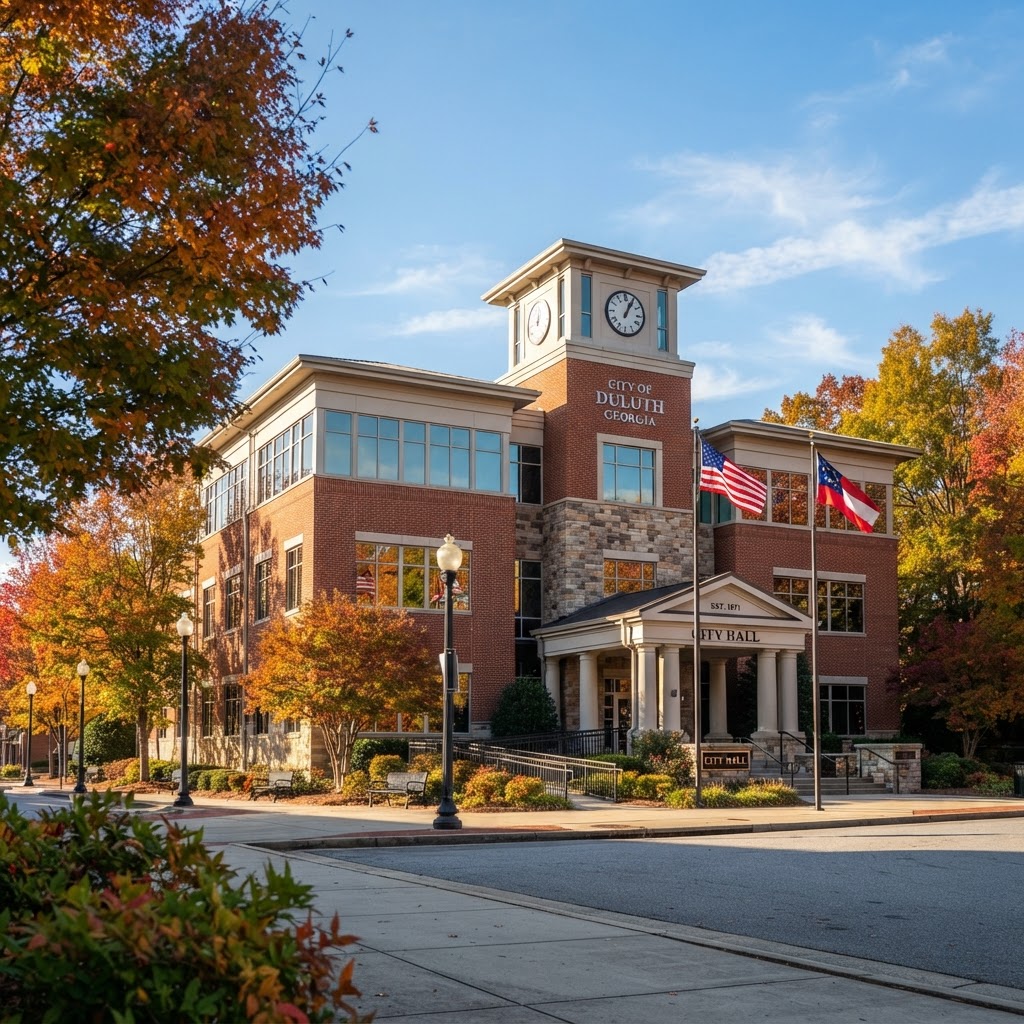
Local Government
Duluth's Tax Allocation District: Where Does the Money Go?
Duluth, Gwinnett County County, Georgia
Duluth is the only city in Gwinnett with its own TAD. We examined the city's audit, council minutes, and bond records to trace where millions in redirected property-tax growth has gone — and who benefits.

Key Takeaways
- •Duluth is the only city in Gwinnett County with its own Tax Allocation District (TAD).
- •The TAD was originally 444 acres, shrunk to 110 acres in 2013 to reset the valuation base and focus on downtown.
- •The city issued $27 million in URA bonds (Series 2021) backed by TAD increment revenue.
- •The URA held $16.5 million in cash but had a negative net position of ($2.7M) as of June 30, 2023.
- •Three private apartment complexes (800+ units) received TAD-funded infrastructure through development agreements.
- •The District at Duluth alone has a taxable value of $33.36 million, making it one of Gwinnett's top taxpayers.
- •The TAD does not increase property tax rates — it redirects incremental property tax growth from rising values within the district.
Duluth, Georgia is the only city in Gwinnett County with its own Tax Allocation District (TAD). That distinction, confirmed by then-City Manager James Riker in a February 2021 presentation to the Citizens Budget Review Advisory Committee, means Duluth has been quietly redirecting property-tax growth from a defined geographic area into redevelopment projects for over a decade.
This investigation reviews the city's Annual Financial Report (FY2023), City Council and Urban Redevelopment Agency minutes, budget documents, and redevelopment planning records to answer: where does the money go, and who benefits?
How Duluth's Tax Allocation District Works
A TAD is Georgia's version of Tax Increment Financing. When a TAD is created, the property tax revenue from properties inside the district is split into two streams.
The first is the base-year amount — the tax revenue those properties generated when the TAD was established. That continues flowing to all participating taxing authorities (city, county, school district) as normal.
The second is the increment — additional tax revenue generated above the base, caused by rising property values and new investment. That increment is redirected into a special fund used to pay for redevelopment projects, infrastructure, or to repay bonds.
Hypothetical example: A property inside the TAD is worth $1 million when the district is established. Ten years later, after redevelopment, it's worth $3 million. The taxes on the original $1 million base go to the city, county, and schools as normal. The taxes on the additional $2 million — the increment — go into the TAD fund.
Once the TAD expires (typically 25 years in Georgia), all property tax revenue reverts to the normal taxing authorities.
When and Why Duluth's TAD Was Created
Duluth's TAD operates under Georgia's Redevelopment Powers Law (O.C.G.A. Title 36, Chapter 44), which requires voter authorization through a referendum.
According to KB Advisory Group (formerly Bleakly Advisory Group), the firm that has managed Duluth's TAD planning since 2010:
"After voters authorized the formation of TADs in Duluth, the City hired Ken Bleakly... to assist in establishing its first TAD. In 2010, the City proposed creating the Buford Highway Corridor Tax Allocation District (TAD) to facilitate the redevelopment of aging commercial properties."
The Downtown Duluth Redevelopment Plan was completed in 2013. At its June 10, 2013 meeting, the City Council authorized an amendment to the TAD at a cost of $12,900. According to Patch.com reporting, the amendment would:
- Reduce the district from 444 acres to 110 acres
- Reset the valuation base (establishing a new baseline for calculating increment)
- Seek Gwinnett County and school district consent to the smaller, downtown-focused TAD
The intergovernmental agreement with Gwinnett County was signed in September 2014, according to Duluth's FY2023 budget document.
Geographic Boundaries
The TAD is located along the Buford Highway corridor, extending north and south from its intersection with Duluth Highway. According to the February 2021 CBRA presentation, the district "encompasses the downtown, portion of Buford Highway, and the development located off Hardy Street."
After the 2013 amendment, the district covers approximately 110 acres. The city has since divided it into lettered development zones (Areas A through G) for planning purposes, as documented in the June 28, 2021 joint City Council/URA meeting minutes.
Which Governments Participate?
| Taxing Authority | Participation | Source |
|---|---|---|
| City of Duluth | Yes (sponsor) | City budgets, audit, council minutes |
| Gwinnett County | Yes | IGA signed September 2014 |
| Gwinnett County Public Schools | Sought; not independently confirmed | 2013 amendment sought "school district consent" |
The 2013 amendment explicitly sought "Gwinnett County and school district consent." Whether GCPS formally participates in Duluth's specific city-level TAD could not be independently verified from available records.
Does a TAD Increase Your Property Tax Rate?
No. A TAD does not increase the property-tax rate. Every property owner pays the same millage rate set by the city, county, and school district.
What changes is where the revenue goes. The tax rate stays the same, but the incremental revenue from rising property values inside the TAD is redirected to the redevelopment fund rather than flowing to general budgets.
A TAD is not a tax increase — it is a revenue redirection. Future tax growth that would have gone to general government operations is dedicated to paying for redevelopment within the district.
For more on how Duluth property taxes work, see our Gwinnett property tax and millage rate explainer.
Follow the Money: The Urban Redevelopment Authority
Duluth's TAD increment flows through the city's Urban Redevelopment Agency (URA), described in the FY2023 budget as "established as a legally separate entity." The URA manages redevelopment projects and can issue bonds.
According to the City of Duluth FY2023 Annual Financial Report:
| URA Financial Position | June 30, 2023 | July 1, 2022 |
|---|---|---|
| Cash and equivalents | $16,479,748 | $20,196,109 |
| Change in cash during year | ($3,716,361) | — |
| Total net position | ($2,742,325) | ($4,446,659) |
Two things stand out:
1. The URA held $16.5 million in cash — a significant sum for a city of ~33,000 residents. This represents unspent bond proceeds and accumulated TAD increment.
2. The URA's net position is negative — liabilities exceed assets by $2.7 million, consistent with the $27 million in bond debt the URA has issued.
The URA's cash decreased by $3.7 million during FY2023, indicating active spending on capital projects.
The $27 Million Bond
The most significant financial obligation tied to Duluth's TAD is a $27 million bond issuance by the Urban Redevelopment Agency.
According to KB Advisory Group:
"That work supported the City's recent decision to issue $27 million in bonds for planned public and private projects within the URA. The tax allocation increments already created within the TAD and additional increments from new projects will repay those bonds."
The June 28, 2021 joint City Council/URA meeting confirmed the bond as the "Series 2021 URA Bond" and referenced the "Intergovernmental Redevelopment Cooperation and Assistance Agreement."
At that meeting, Finance Director Ken Sakmar reported that $7.5 million remained from the bond for additional projects. The council and URA recommended three priority areas:
- TAD Area B3 (office space and parking deck on Buford Highway)
- TAD Area A (Buford Highway from Davenport Road to the car wash)
- TAD Area F (Buford Highway facing businesses, including Magnolia Medical Clinic, Dairy Queen, and Procter Square Apartments)
The bond is repaid from TAD increment revenue. If incremental property values don't grow as projected, the bond obligation remains.
Where Duluth's TAD Money Has Gone
The June 2021 City Council/URA minutes document specific projects funded through the TAD:
| Project | Status (June 2021) | Category |
|---|---|---|
| Regional Detention Pond (Res. #1) | Complete ($0 remaining) | Infrastructure |
| District at Duluth infra (Res. #2) | $731,000 remaining | Private dev support |
| Greystar-Everleigh infra (Res. #3) | $900,000 remaining | Private dev support |
| Resolution #4 project | $2,100,000 remaining | Not specified |
| Traffic signal at Davenport Rd & Buford Hwy | Design phase | Public infrastructure |
| Davenport Sewer Extension | Developer-funded (SODO) | Utility infrastructure |
| Thrive property (Main Street) | Proposed | Office/restaurant |
| Paver Lot Conversion ("Jewel Box") | Proposed | Public space |
| Library streetscaping (Main Street) | Proposed | Streetscape |
| Downtown drainage improvements | Proposed | Infrastructure |
KB Advisory Group also documented Parson's Alley — a restaurant-centric development on the former City Hall site, developed by Fabric Developers under a development agreement with the City — and the $4.5 million sale of 20 acres of City-owned land to Lennar, "fully recovering the City's site assembly costs."
Have Private Developments Benefited?
Yes — at least three private apartment developments received TAD-funded infrastructure through development agreements, totaling more than 800 units:
| Development | Units | Developer | TAD Support |
|---|---|---|---|
| District at Duluth | 380 | Residential Group | Res. #2 ($731K remaining) |
| Greystar-Everleigh | 180 | Greystar Developers | Res. #3 ($900K remaining) |
| Second Residential Group project | 258 | Residential Group | Development agreement |
| SODO Duluth | 253 | SODO | Installing Davenport Sewer Extension |
The District at Duluth alone has a taxable value of $33,360,000, according to Gwinnett County's FY2021 financial report, which lists "USPA District at Duluth LLC" among the county's top taxpayers.
KB Advisory Group explicitly states it "drafted development agreements to provide funding to three new apartment complexes within the TAD, totaling more than 800 units."
This is the core tension: public TAD funds have been used to build infrastructure (sewer, roads, traffic signals, drainage) that directly serves private developments. Whether this represents a worthwhile public investment depends on whether the new tax base exceeds the cost of the infrastructure provided.
For the broader question of who pays for Duluth's growth, see our comprehensive investigation.
What Would Happen Without the TAD?
Without the TAD, the incremental property tax revenue from rising values within the district would flow to the general budgets of the City of Duluth, Gwinnett County, and (if participating) Gwinnett County Public Schools.
This does not necessarily mean those governments "lost" money. The redevelopment itself may have created property value that would not have existed otherwise. The question is whether the public investment produced enough new value to justify the redirected revenue.
This connects to the same question examined in our investigation of Gwinnett County's $2.58 billion budget.
Has Duluth's TAD Delivered Results?
Partially achieved — property value growth: The District at Duluth alone contributes $33.36 million in taxable value. Three apartment complexes totaling 800+ units have been built within the TAD.
Partially achieved — downtown revitalization: Parson's Alley has created a restaurant-centric gathering space. The Lennar development produced 100+ housing units. Downtown streetscape improvements have been made.
In progress — infrastructure: The Davenport Road traffic signal and sewer extension were still in design as of June 2021. Several proposed projects had not yet broken ground.
Not yet verifiable — bond repayment: The $27 million bond is repaid from TAD increment. Whether increment revenue is sufficient to fully repay the debt cannot be determined from available statements. The URA's negative net position of ($2.7M) as of June 30, 2023, indicates liabilities still exceed assets.
Five Things Duluth Residents Should Know
1. The TAD was originally 444 acres and was shrunk to 110 acres in 2013. The amendment "reset the valuation base," meaning the original base year was changed and a new baseline was established.
2. The city has issued $27 million in bonds backed by TAD increment. The Series 2021 URA Bond is repaid from tax increment revenue. The URA's net position is negative $2.7 million as of June 30, 2023.
3. Three private apartment complexes received TAD-funded infrastructure through development agreements. KB Advisory Group states it "drafted development agreements to provide funding to three new apartment complexes within the TAD, totaling more than 800 units."
4. The District at Duluth is one of Gwinnett County's top taxpayers at $33.36 million. This single property generates significant TAD increment. Its infrastructure was also supported by TAD funding through Resolution #2.
5. The TAD was amended for $12,900 in consulting fees. The 2013 amendment that reshaped the district from 444 to 110 acres and reset the base value cost the city $12,900 in payments to Bleakly Advisory Group (now KB Advisory Group).
Connection to Duluth's Development Boom
The proposed 1,400-home Portman Holdings development at Pleasant Hill Road and Peachtree Industrial Boulevard falls outside the TAD boundaries and is not connected to TAD financing. The TAD is focused on the Buford Highway corridor and downtown area.
However, the TAD is one of several mechanisms the city uses to manage growth. Understanding how it works is essential context for evaluating every new development proposal, including the traffic and infrastructure challenges that growth creates.
What Could Not Be Independently Verified
- Exact date of the voter referendum authorizing TADs in Duluth
- Whether Gwinnett County Public Schools formally participates in Duluth's city-level TAD
- Exact annual TAD increment revenue for each year (the URA's overall position is reported, but TAD increment is not broken out separately)
- Bond terms — interest rate, maturity date, and debt service schedule
- Original base-year taxable value of properties within the TAD
- Specific termination date of the TAD (Riker stated TADs typically operate for 25 years, but the exact expiration was not confirmed)
Official Documents & Sources
- City of Duluth FY2023 Annual Financial Report
- June 28, 2021 Joint City Council/URA Minutes
- February 17, 2021 Citizens Budget Review Advisory Committee Minutes
- KB Advisory Group Duluth TAD Case Study
- Patch.com: Duluth TAD Amendment (July 2013)
- City of Duluth FY2026 Budget
- Gwinnett County FY2021 Financial Report
- Gwinnett County TAD Policy
- Georgia Redevelopment Powers Law (O.C.G.A. Title 36, Ch. 44)
More Gwinnett County Coverage
For more reporting from across Gwinnett County — Lawrenceville, Duluth, Norcross, Snellville, Suwanee, and every community in the county — visit our Gwinnett County news hub, or browse all local news from WorthFighting.org.
Sources
- City of Duluth FY2023 Annual Financial Report (Audit)
- June 28, 2021 Joint City Council/URA Minutes
- February 17, 2021 Citizens Budget Review Advisory Committee Minutes
- KB Advisory Group Duluth TAD Case Study
- Patch.com: Duluth TAD Amendment (July 2013)
- City of Duluth FY2026 Budget
- Gwinnett County FY2021 Financial Report
- Gwinnett County TAD Policy
- Georgia Redevelopment Powers Law
Explore Georgia
Explore more news, elections, representatives, and information from Georgia.
Visit Georgia State ProfileMore Gwinnett County coverage
Explore the County Government hub, the Gwinnett County hub, and related topic hubs.