
Dauphin Island · Local Government
Dauphin Island Airbnb controversy: rental rules and property rights
At a glance
Dauphin Island’s Airbnb debate concerns where short-term rentals belong, how licenses should be regulated and how to balance owners’ interests with neighborhood conditions. Posted Ordinance 105 rules are separate from proposed 105-A changes and historical moratorium actions. This article explains the debate; the linked rental-rules tracker provides dated requirements, proposal labels and the limits of the available current-status record.
Editorially updated . Evidence dates and record limits are stated separately.
Originally published · WorthFighting.org Editorial Team
Current rules, proposals and the next records to check
The Town rental-license page still posts Ordinance 105 and three STR overlay districts. 105-A is proposed; adoption is not established in the records reviewed. The July 7, 2026 60-day moratorium extension is a dated council action, not proof of an active moratorium today. The online minutes index, checked October 5, lists September 1, 2026 as its latest linked council minutes. Check an adopted ordinance, effective date and any later extension before relying on a new rule.
For parcel-specific decisions, confirm the district, approval requirements and applicable permits with the Town. See Dauphin Island short-term rental rules and proposed Dauphin Island Ordinance 105-A.
The sign on the bridge to Dauphin Island still reads "Sunset Capital of Alabama." But the quiet barrier island at the mouth of Mobile Bay is wrestling with a question that has nothing to do with sunsets: Who is Dauphin Island for?
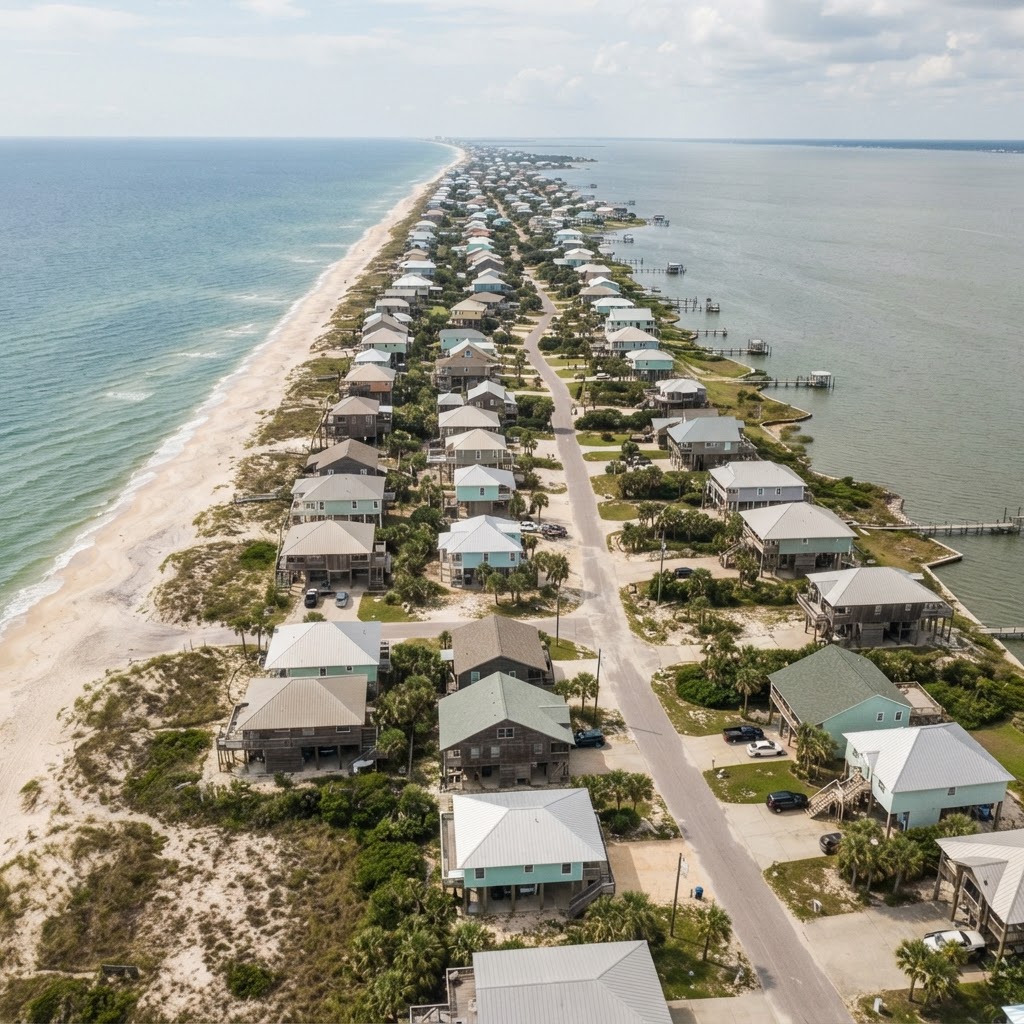
Roughly 1,800 people live there year-round. Hundreds more own vacation homes. And on any given summer weekend, thousands of visitors stream across the three-mile bridge to rent those homes through Airbnb, Vrbo, and local property-management companies.
Now a proposal to clamp down on short-term rentals in one of the island's gated subdivisions has property owners and permanent residents locked in a fight that mirrors a larger Gulf Coast debate — one that has already landed in federal court across the state line in Biloxi, Mississippi.
Why Dauphin Island Is Different
Dauphin Island is Alabama's only barrier island — a narrow, seven-mile strip of sand between the Gulf of Mexico and Mobile Bay. It has no factory, no industrial base, and no sprawling commercial district. The economy runs on tourism, fishing, and the vacation-rental market that has grown up around both.
Mayor Jeff Collier describes the dynamic as a daily balancing act. "It's a tug-of-war going on," he told AL.com. "I deal with this on an almost daily basis."
The 2020 Census counted roughly 1,800 year-round residents — up about 400, or 35%, from the prior count. The town has been building 60 to 80 houses a year for the better part of a decade. Many are not primary residences but investment properties, retirement placeholders, and weekend getaways owned by people who live in Mobile, Birmingham, Atlanta, and points north.
That growth has turned a sleepy fishing community into something closer to a resort town — and it has forced local government to decide how much vacation-rental activity a residential island can absorb before it stops feeling like a community at all.
How Big the STR Market Has Become
A decade ago, Dauphin Island had almost no short-term-rental regulations. That changed as the market exploded. Third-party analytics firm AirDNA estimated roughly 870 active short-term rental listings on Dauphin Island as of July 2026, with the average active listing generating about $62,500 in annual revenue. Another service, AirROI, pegged average annual revenue closer to $37,100 at a $400 nightly rate and roughly 34% occupancy. Those are commercial estimates, not official government statistics, but they illustrate the scale of an industry operating alongside fewer than 2,000 permanent residents.
The town's response was Ordinance 105.
What Ordinance 105 Actually Says
Adopted in 2024 after more than a year of Planning Commission debate, Ordinance 105 established the town's first comprehensive short-term-rental regulatory framework. It defines a short-term rental (STR) as any residential dwelling rented for no more than 179 consecutive days, and a long-term rental as 180 days or more.
The ordinance created three Short-Term Rental Overlay Districts:
- STROD1 covers R-1 and Village-zoned properties on the eastern end. It caps rentals at 90 licenses, requires a 3-night minimum stay, and allows one vehicle per two adults.
- STROD2 covers R-1 properties along Cadillac Avenue. It caps rentals at 70 licenses with the same 3-night minimum.
- STROD3 covers the western end — the traditional tourist corridor — with no license cap and only a 2-night minimum.
Crucially, the ordinance excludes gated communities like DeSoto Landing and Audubon Place from the overlay districts entirely. Those subdivisions set their own rental rules through private covenants — a deliberate decision to let homeowners' associations, not the town council, govern what happens behind their gates.
Every rental property must obtain an annual business license. The posted base fees are $125, $150 and $225 by gross-receipts bracket, plus a $10 issuance fee; the lowest-bracket total is $135. The town requires a safety inspection every three years by a certified inspector, and lodging taxes total 13% — town 7%, state 4%, Mobile County 2%. The town maintains a 24-hour complaint hotline.
DeSoto Landing Becomes a Flashpoint
For two years, the overlay-district system held. But in early 2026, the fight reignited — inside one of the gated communities the ordinance was designed to leave alone.
On March 11, 2026, a group of DeSoto Landing property owners circulated a petition to the Town Council formally opposing a proposed amendment to Ordinance 105 that would place a short-term-rental moratorium and a cap on the number of STRs allowed within the DeSoto Landing subdivision.
The petition, which had gathered 56 signatures as of mid-2026, argues that the proposed amendment would "negatively impact the 87 property owners of DeSoto Landing." It states that the DeSoto Landing Covenants and Restrictions already allow short-term rentals with a 7-night minimum term, and that a "small minority of owners have requested the Dauphin Island Town Council to bypass the covenants and restrictions."
The comments are blunt. "So if the town can just change the rules whenever they feel like it what is the point of having covenants in the first place?" wrote one signer, Keith Fisher. Another, Linda Morrison, wrote: "This is my investment property. I depend on that income to pay the high taxes and upkeep."
The tension inside DeSoto Landing stands in contrast to Audubon Place, the island's other major gated community, where social-media posts from residents have claimed that a strong majority of owners want to restrict or eliminate short-term rentals.
As of publication, the proposed DeSoto Landing amendment has not been verified as adopted in the reviewed records. It remains under consideration by the Town Council, and the petition represents the position of the property owners who organized it — not a final vote or a binding referendum.
Why Rental Owners Are Fighting Back
The property owners opposing the moratorium make an argument that goes to the heart of conservative property-rights doctrine: they bought under one set of rules, and the government should not retroactively change them.
"We all purchased property under one set of rules with the understanding that we could rent our properties and now it's being changed," Justin Warren, who owns three homes on the island's east end, told WKRG. "For many people this is a financial burden."
Leanne Potts, a part-time resident who rents her cottage on the east end, was even more direct. "I think this is a complete government overreach," she told 1819 News. "They're taking my property rights away with very little information or facts or data."
Potts argues that the town already has the tools to deal with problem rentals — a full-time police department, a building department, noise ordinances, nuisance ordinances, and trespass laws — and that it should enforce those rules against bad actors rather than restricting the property rights of everyone.
"They have tools in place that if there are problems with some of the short-term rentals, they have the tools in place to manage that," Potts said. "We need to manage the development that's happening, not outlaw the short-term rental people."
Mayor Collier acknowledged the force of that argument. "They're saying, 'Why just blanket cut all these out? Why can't we manage these better?'" he told 1819 News. "If they're making too much noise, we have a nuisance ordinance, we have a noise ordinance. If they're trespassing on a neighbor's property, there are trespass laws."
What Residents Are Concerned About
The other side is equally grounded in conservative principles — specifically, the principle that a community has the right to govern itself and protect its character.
Councilman Earle Connell told AL.com that the town has received "a lot of complaints" about short-term rentals in residential neighborhoods. "One group will say they are renting out (their house) and the next thing you know is you have eight cars parked all over the yards," he said.
Domenic Carlucci, then-president of the Dauphin Island Property Owners Association, told 1819 News that complaints had centered on the east end. "There are disturbances in that area, people are out partying at night, and when those people bought there, they didn't sign up for that," he said.
The argument from residents is not that tourism is bad — the island depends on it — but that a residential neighborhood and a rotating cast of weekend vacationers are fundamentally different land uses, and that a small barrier island with limited infrastructure and a single road on and off cannot absorb unlimited transient occupancy without losing the qualities that make people want to live there permanently.
Councilman Gene Fox, a Realtor and former business owner, told AL.com that restricting short-term rentals on the east end would concentrate tourism on the west end — the same west end that floods repeatedly during tropical storms. "There is no other industry on Dauphin Island, like a factory to go work in," Fox said. "That's literally where the jobs come from is the tourism industry."
The Property-Rights Question
Beneath the specifics of overlay districts and license caps lies a question that ought to make every conservative pause: When someone buys a home, how much authority should local government have to tell that owner whether it can be rented to vacationers?
The property-rights case is strong. A home is the largest investment most Americans will ever make. When a family buys a beach cottage intending to rent it out during the summer to cover taxes, insurance, and maintenance — and then retires to it — they are making a financial decision based on the rules in effect at the time of purchase. Changing those rules retroactively is a serious interference with investment-backed expectations.
There is also a legitimate concern about government overreach. The idea that a town council can override private subdivision covenants — documents that property owners relied on when they bought — raises a question about the limits of local government authority that extends well beyond beach rentals.
But there is also a conservative case for local control. The same principles that support property rights support the right of a community to establish zoning rules that protect residential character. A town is a self-governing political body, and its residents have the right to decide, through their elected officials, whether their neighborhoods should function as neighborhoods or as de facto hotel districts.
The tension is real. Aggressive enforcement of noise, parking, trash, and occupancy rules — the approach Potts and other owners advocate — can address many of the concrete problems without broadly restricting the right to rent. But enforcement-only approaches have limits: they react to problems after the fact, they require staffing and political will, and they do not address the structural question of whether a residential zone should contain hundreds of transient-lodging units at all.
Dauphin Island's current ordinance tries to split the difference — capping licenses in residential districts, leaving the tourist-heavy west end open, and letting gated communities govern themselves. The DeSoto Landing proposal would upset that balance by extending town authority into a gated community that was explicitly excluded from the overlay system.
What Happens Next
The DeSoto Landing proposal remains under consideration by the Dauphin Island Town Council. If adopted, it would be the first time the town extends its short-term-rental authority into a gated community that Ordinance 105 deliberately left to its own covenants — a precedent that property owners across the island are watching closely.
If it fails, the town will continue to operate under the existing overlay-district system, with its license caps, safety inspections, and 24-hour complaint hotline, while gated communities continue to self-govern.
Either way, the underlying question will not go away. Dauphin Island is a small place with a big tourism economy, and the people who own property there — whether they live there full-time, visit on weekends, or rent to strangers — are all stakeholders in what the island becomes.
The conservative answer is not to pick a side. It is to insist that the process be transparent, that the rules be knowable in advance, that government enforce the laws it already has before reaching for new ones, and that the property rights of people who invested in good faith be treated as more than an afterthought.
Dauphin Island's future will be decided by the people who show up at town council meetings, sign petitions, and vote in local elections. That is how self-government is supposed to work — even on an island where the biggest daily question used to be whether the sunset would be spectacular enough to stop traffic on the bridge.
Frequently Asked Questions
Are short-term rentals legal on Dauphin Island?
Yes. Short-term rentals are legal under Ordinance 105, which defines a short-term rental as any residential dwelling rented for no more than 179 consecutive days. Rentals are regulated through three overlay districts with license caps and minimum-stay requirements. All rental properties must obtain an annual business license and pass a safety inspection every three years.
What is the DeSoto Landing controversy?
In March 2026, DeSoto Landing property owners circulated a petition opposing a proposed amendment to Ordinance 105 that would place a moratorium and cap on short-term rentals within the subdivision. The petition argues that the subdivision's private covenants already allow rentals and that the town should not override them. Adoption of the proposal is not established in the records reviewed.
How many short-term rentals are on Dauphin Island?
Third-party analytics firm AirDNA estimated roughly 870 active short-term rental listings on Dauphin Island as of July 2026. These are commercial estimates, not official government statistics.
What is the Airbnb lawsuit against Biloxi about?
In November 2025, Airbnb and a Mississippi homeowner sued the City of Biloxi in federal court, alleging that the city conspired with the Mississippi Hotel & Lodging Association to restrict short-term rentals and protect hotel profits in violation of antitrust laws. The case (No. 1:25-cv-00333-TBM-RPM) is pending in the U.S. District Court for the Southern District of Mississippi. It does not directly control Dauphin Island, which is in Alabama, but reflects the same Gulf Coast debate over property rights and local regulation.
The Bigger Picture: What Are Residents Fighting For?
The short-term-rental debate is one part of a larger question about Dauphin Island's future. Read our broader investigation into what Dauphin Island residents are fighting to protect — zoning, development, beach access, and the future of Alabama's barrier island.
Related Resource: For the detailed reference page tracking the posted STR districts, license caps, minimum stays, dated moratorium actions, and proposed Ordinance 105-A — all with dated primary sources — see Dauphin Island Short-Term Rental Rules: What Is in Force and What Is Proposed.
Related Dauphin Island guides
- Dauphin Island rules, restoration and visitor guides
- Dauphin Island short-term rental rules in 2026
- Dauphin Island tree ordinance 87B: current text and proposed changes
- Dauphin Island building codes, dune protection and coastal permits
- Dauphin Island West End beach easements: what owners should verify
Updated October 5, 2026. Source dates and unresolved questions are identified above.
Sources and public records
- Town of Dauphin Island — Rental Hub
- AL.com — Tourists or locals? Dauphin Island wrestles with regulating short-term vacation rentals (Aug 2022)
- WKRG — Dauphin Island might only allow short-term rentals on the west end (Aug 2022)
- 1819 News — Property owners who rent on Dauphin Island oppose changes to zoning ordinance (Aug 2022)
- NBC 15 (WPMI) — Zoning proposal could limit short-term rentals on Dauphin Island (Aug 2022)
- Reuters — Airbnb sues Mississippi city over short-term rental restrictions (Nov 2025)
- iPetitions — DeSoto Landing Owners Object to Restrictions on Rental Properties (March 2026)
- AirDNA — Dauphin Island, AL Airbnb & Short-Term Rental Data (2026)
- Meredith Harris — Short Term Rental Restrictions on Dauphin Island AL (Sept 2024)